
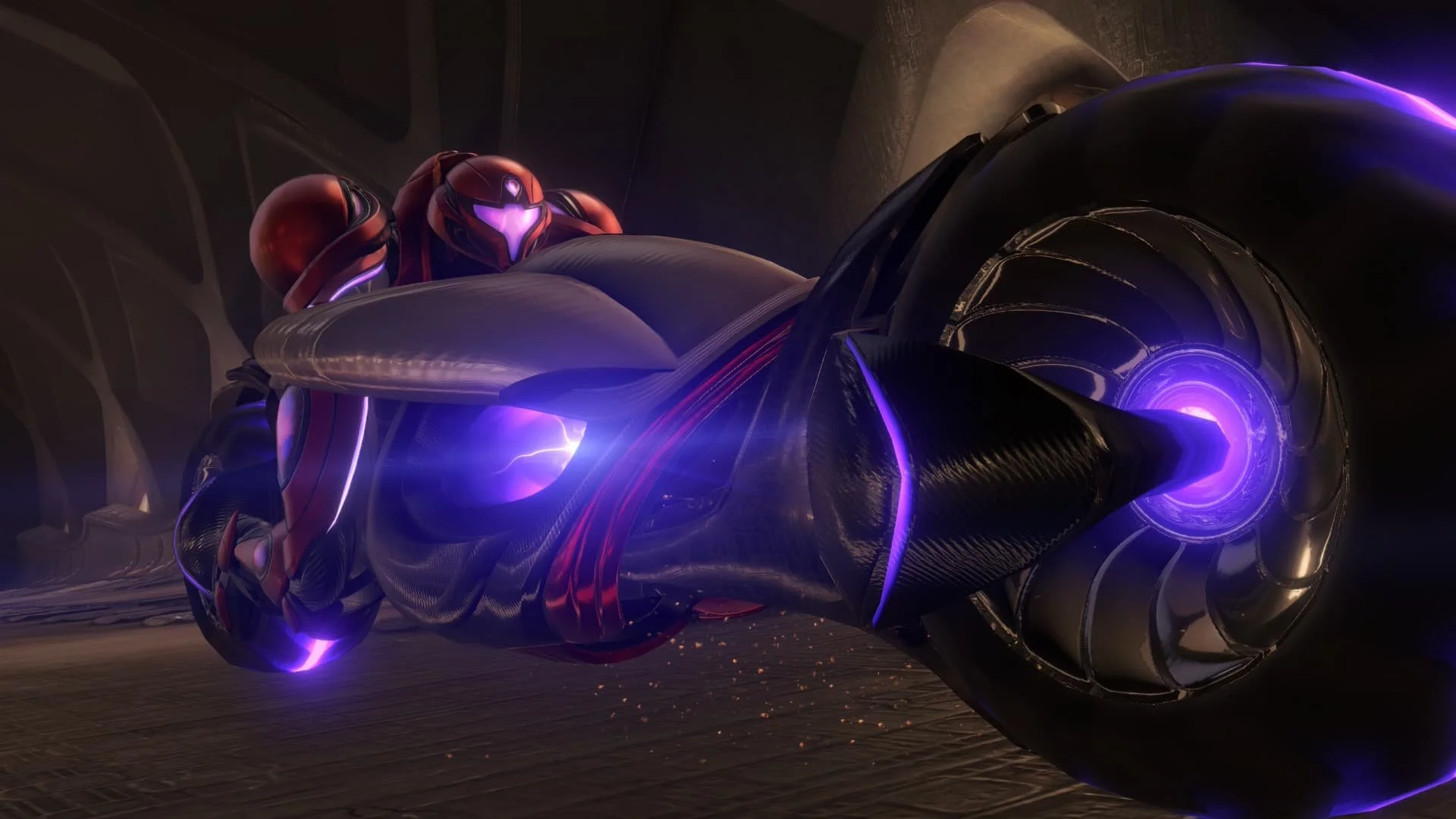
Eighteen years is a heck of a long time to wait for a sequel, but we fans never forgot. When Metroid Prime 4: Beyond was first announced in 2017 with just a logo, Samus Aran’s latest still took the world by storm. Finally, we would have a hardcore first-party Metroid Prime adventure to follow-up on the 2007 cliffhanger left by Metroid Prime 3: Corruption. Then came the delays - Nintendo even released a rare apology video in 2019. Press and marketing was dead silent for years, prompting rampant speculation, and while the initial 2025 trailer wowed with excellent graphics, the first play-test drew mixed reactions. But my hopes were still high. The first two Metroid Prime titles are among my favorite games of all time, and the recent Metroid Prime Remastered garnered a perfect score from me, so it’s a tough act to follow. Much like the labyrinths Samus usually explores, there’s no easy answers here.
The game begins with a cinematic space dogfight. Samus Aran drops in to assist a Galactic Federation base under siege by Space Pirates. Their target? A mysterious ancient artifact. The in-media-res tutorial introduces combat mechanics and scanning, and features heavy voice-over from the troopers. Aside from how crisp everything looked and ran on the Switch 2 and how smooth the combat felt at first glance, nothing else about this intro wowed me. The Space Pirates are still not very intelligent fighters and will simply stand in place or half-heartedly dodge while shooting. Scanning seemed to take too long - around two seconds for every item, including crates. They also give you an Energy Tank before the first boss. Then Sylux appears for a matter of seconds. In a cut-scene, he accidentally disrupts the artifact, sending him, Samus, and a handful of Galactic Federation troopers off to their own corners of the far-flung planet of Viewros.
Controls are fine, but combat options and enemy variety are sorely lacking
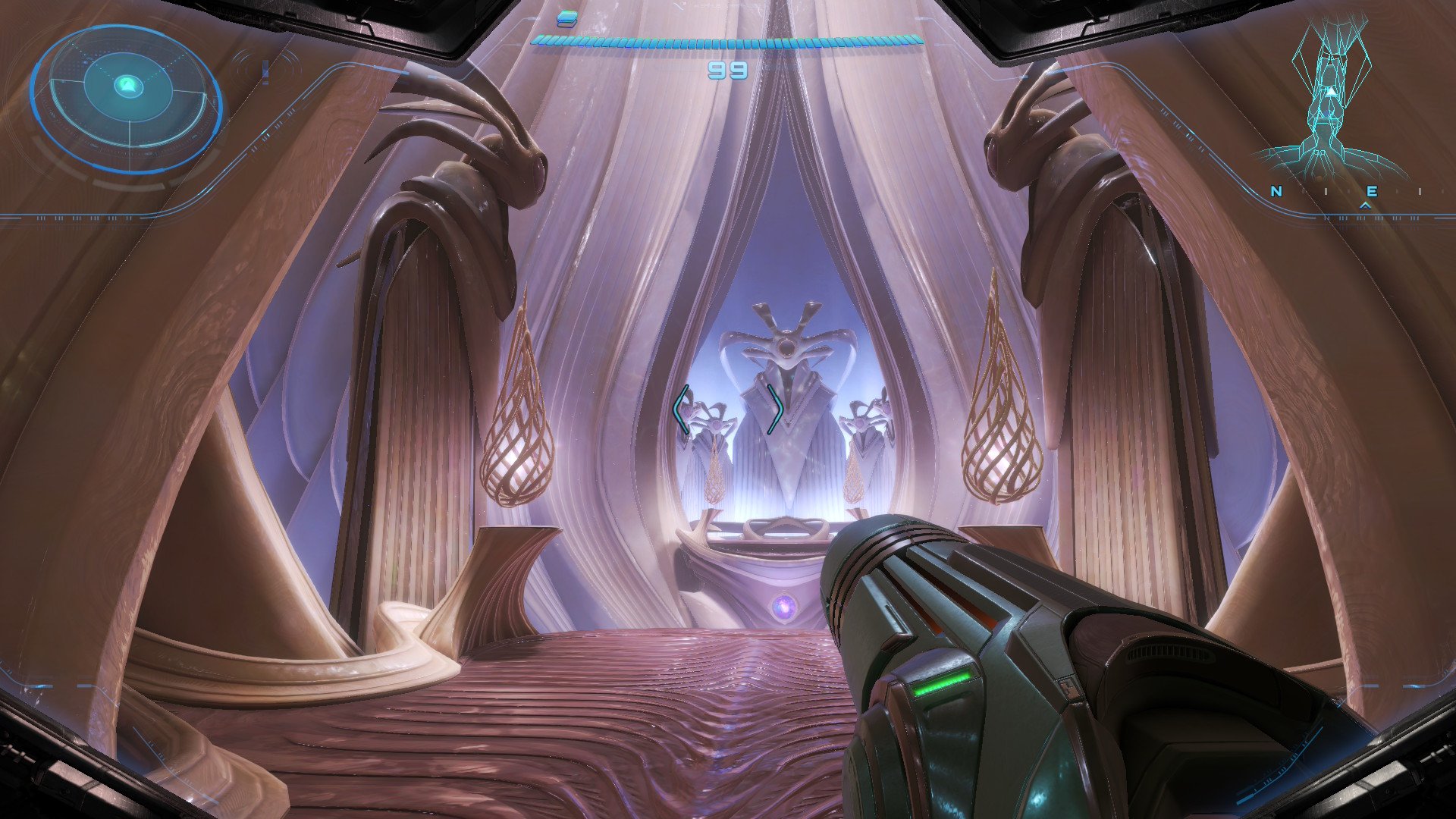
Once on Viewros, the developers must have expected players to be impressed by the otherworldly Chronos Tower and the subsequent Fury Green, which feature doors and hallways clearly inspired by intimate parts of the female anatomy. Via telepathic statues and hologram recordings, Samus learns that the planet was once inhabited by the Lamorn, a now-defunct species whose ‘Chosen One’ prophecy claims that someone will come from the stars to carry on their memory. It doesn’t provide a strong hook, but it’s serviceable. Samus is then whisked down corridors until she chances upon a chatty NPC in need. Saving the infamous engineer Myles Mackenzie is mandatory, as is listening to his random, unskippable calls throughout the game, but thankfully, he’s only tethered to your side until you reach the end of Fury Green.
All throughout, you’ll be scanning, dodging, and shooting. But it’s only later on, when the unfortunately-named “Green Energy” rains down, that your primary foes, the Grievers, become more of a threat. Actually, while Prime 4’s combat largely feels fine, its fundamentals are flawed and archaic. For instance, missiles are too slow against 90% of foes and do less damage than your regular beam, making them and their upgrades useless. You can’t charge a Super Missile without firing off a missile during the initial charge. And when you lock-on using the Pro Controller, your cursor automatically returns to center screen with a slight delay before the next input, which is frustrating during certain encounters where you need to quickly target areas just to the side of center and have already gotten your cursor in position, but don’t want to fight the camera.
I found that I didn’t really take to either the mouse or gyro controls. I have a chunky dbrand Killswitch 2 grip on my Joy-Cons, for comfort. However, even the added beefiness didn’t help me to hit those awkward, tiny face buttons while attempting to hold the Joy-Con 2 sideways. The gyro controls felt all right, but they weren’t as accurate as the Wii Remote, and I didn’t want to deal with wrist strain. Thankfully, even with the Pro Controller, you can tilt the whole unit and achieve subtle motion-controlled aiming. It’s probably the most intuitive use of this controller feature I’ve seen yet. Adjusting my stick sensitivity and using subtle motion aiming helped things feel fast and responsive.
However, the absolute worst thing about the controls is the fact that the command to dash is a double-tap of the jump button, combined with a stick movement. It never feels great. The game assigns jump to both B and L, but I would have easily traded one of those for the possibility of assigning a dedicated dash button. Additionally, there’s three elemental beams and, later, their charged variants. None are as fun as the alternate beams in previous Prime games, and situational exceptions aside, Samus’ uncharged regular shots are somehow the best choice for combat, as they can be fired rapidly and rack up the most damage. This is like if Mega Man’s lemons were the best weapon in nearly every scenario. Absurd.
A Planet of Decent Bosses, Bland Foes, and Green Crystals… but no Space Pirates?
Perhaps it’s not Samus’ loadout or moveset so much as it is the limited AI and the lack of enemy variety that made things feel stale. There’s a small pool of foes you’ll be tackling throughout this quest. After the initial sequence, Space Pirates are not in the game at all, which is strange, because they were primary antagonists in much of the Prime trilogy, and Sylux was fighting alongside them before being whisked away to Viewros. In previous games, you’d have a lot of memorable Space Pirate encounters, with bodies to scan and logs to peruse. They also created some of the most interesting bosses, such as Metroid Prime’s Omega Space Pirate. Having them be totally absent leaves a huge void, especially as the game has a serious lack of enemy variety, with a total of 30 enemy types versus the first Metroid Prime’s 70.
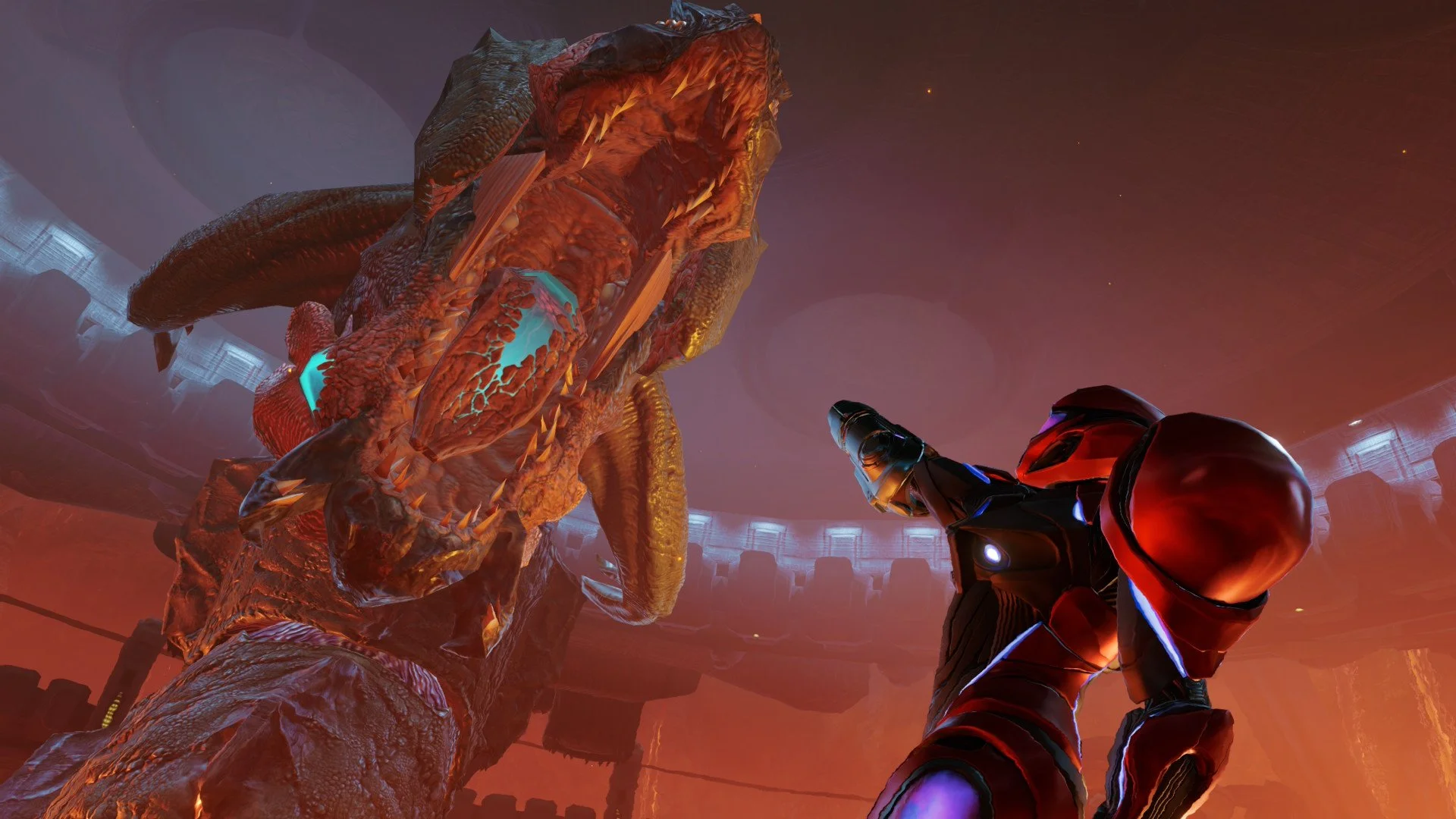
There’s sadly far less bosses than in previous Metroid Prime games, but I found them to be easily the game’s highlight, so much so that I wished for a Boss Rush or Boss Time Attack mode. Some are actually challenging, such as the Omega Griever and final boss, but others, like Phenoros from Flare Pool, I downed without dying once. Sylux also provides three memorable encounters (out of the game’s 8 bosses, he’s 3 of them), although he almost never speaks, and what we learn of his backstory is simultaneously sparse and disappointing. There’s a special cut-scene unlocked after achieving 100% completion, and it’s a letdown.
Do you enjoy corridors? Do you dislike exploring? This might be the Metroid for you
But if the bosses are beastly, the biomes they inhabit could have used a boost. The game boasts five distinct biomes (six if you include Sol Valley), but none of them are biomes in the traditional Metroid sense. Rather than interconnected vertical and horizontal labyrinths with plenty of cool lore elements and secrets, you’ll mostly be going through corridors, elevators, and hallways of various makes, often with crossroads split into three ways: a save or map room, a dead end until you have X item, and the way forward. When you return later on in the game, you’ll know exactly where to go, as the easily accessible maps will show you rooms you haven’t explored yet.
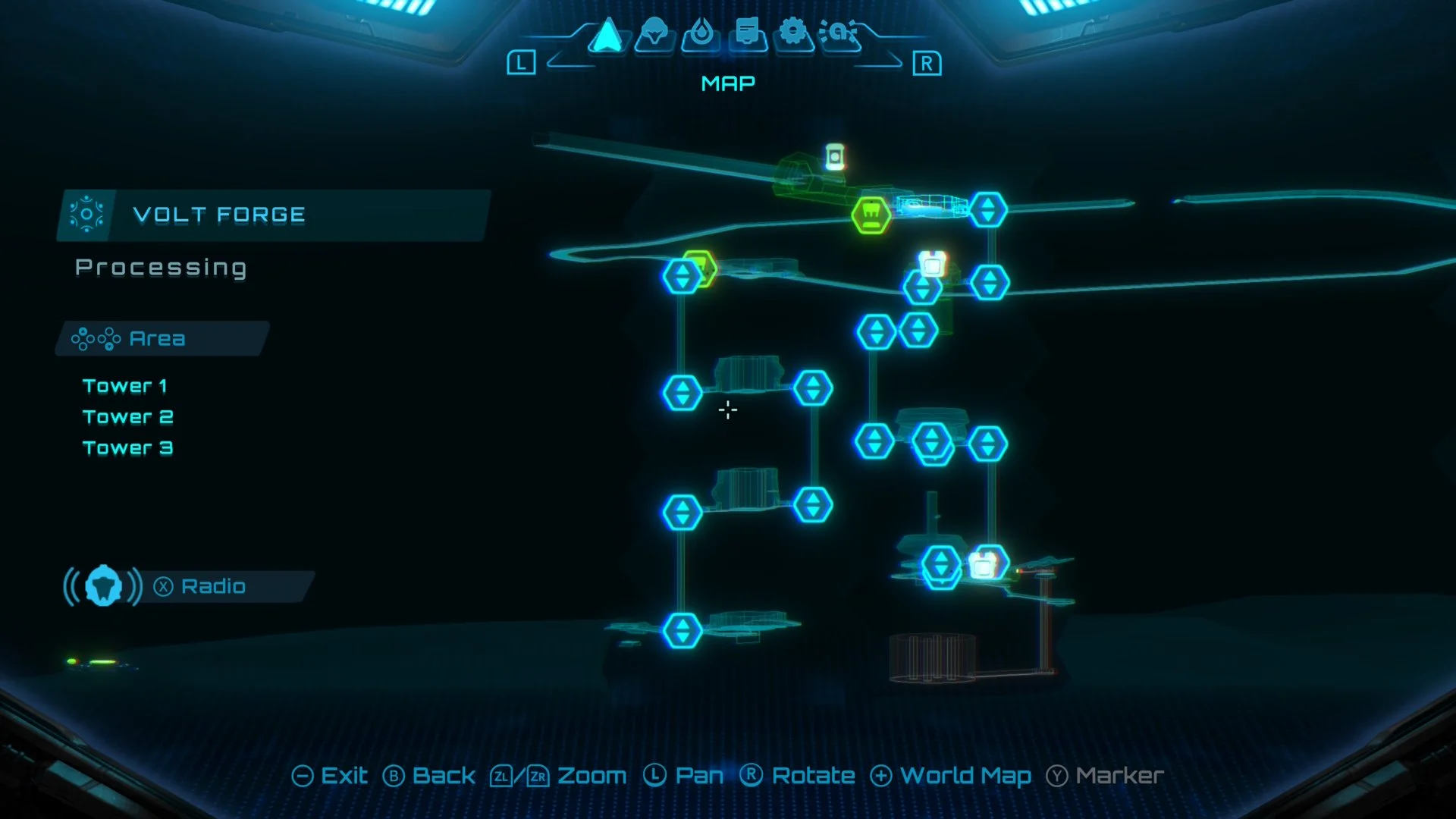
This is definitely my chief complaint about the game, and because of the utter lack of wanderlust, Prime 4 is simply not a Metroidvania. I found myself actively avoiding checking the maps, so that I could try and challenge myself, but the game always highlights the path forward. What’s more, they have added markers, so for the first time, you can mark a section of the map for later exploration.
That’s not to say that the areas are entirely terrible. Volt Forge and Ice Belt are atmospheric, and Fury Green does feel alive. The biomes are simply straightforward. There’s a mandatory Myles call early on in Volt Forge where he tells you exactly what to do, as if you had a choice. Not once in the five small biomes of Metroid Prime 4: Beyond was I asking, “Where shall I go next?” In fact, if you ever get the itch to just drive around and explore the overworld, you can count on Myles calling out of the blue in the first five minutes to tell you exactly where to go, and he’ll remind you every subsequent seven minutes afterwards. Following this call, the location of the next objective is not only marked on your map, but the game puts a large green “Open Map” icon in the middle of your screen that never goes away until you hit the button, essentially forcing you to be subjected to information you might have wanted to discover on your own. What’s insane is that there is a persistent option to call Myles advertised on the map screen, so they could easily have made all of these calls completely optional.
The worst part? After you beat the second area, Volt Forge, Myles will tell you that you can tackle the remaining 3 keys in any order. However, there is only one sequence of events that will allow you to progress. You’ll need to drive to Flare Pool, grab the Fire Chip, then drive back to Fury Green and walk to Myles to install it (because now Samus somehow needs a Galactic Federation engineer to install certain upgrades), and then drive to the Ice Belt. Until you do that specific sequence of events, you won’t make any progress in the game. This is one of the most egregious instances of an NPC outright lying to the player that I have ever seen. I must chalk it up to limited playtesting, negligence on the part of the translation team, and/or a general lack of care or respect for the players’ time. Speaking of wasting time, there’s at least one minute of loading screens and corridors between the desert and the entrance to each area.
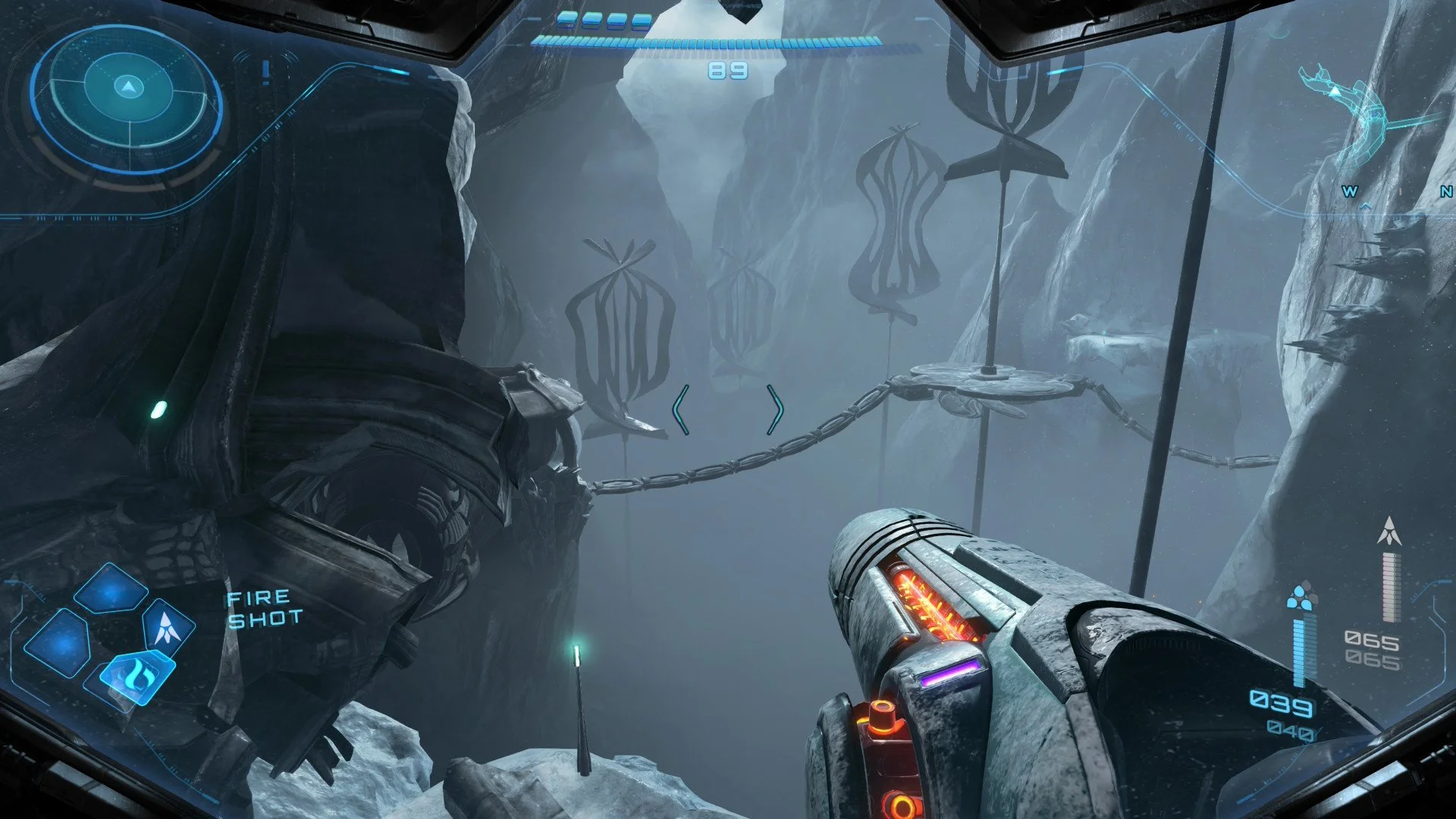
Maybe for many, this won’t be the end of the world. But for those who like to explore at their own pace and find things out for themselves, there’s nothing more annoying and immersion-breaking than an NPC chiming in to say, “Have you fully explored the Ice Belt yet? Maybe try out your latest ability there.” (And of course, the area in question is right by the entrance.) It also doesn’t make sense lore-wise that Myles would have God-level knowledge of the planet. It is fourth-wall breaking, and reveals that the game doesn’t trust the player. Later on, there’s probe droids that you can activate. Once you shoot them with the electric beam, they’ll leap into the air and scan the surrounding area for hidden items. Wasn’t that my job in games past? On the flip side, if you don’t scan these areas, you’re guaranteed to miss said objects, because they’re not ‘meant’ to be found by normal means. So this gimmick adds nothing, and is instead a crutch for poor design.
Because the unique first-person action-adventure gameplay of the Metroid Prime series is so rare and the level design in those first three games is so unmatched, the linearity of Prime 4’s biomes and their uninspired layouts are by far the game’s most disappointing aspect. You couldn’t miss a secret if you tried. The vast majority of rooms are corridors or small action arenas. Nearly every “puzzle” simply involves using the correct ability, such as tracing an on-screen pattern, and Samus’ psychic abilities feel gimmicky.
Gone are the environmental puzzles, such as the room in Metroid Prime’s Chozo Ruins where you had to raise and lower the water levels. In games past, the maps were like labyrinths, and they structured zones carefully with creatively interconnected rooms, so that backtracking later on would cut down on traversal. One of the most special and beautiful aspects about Metroid Prime and Metroid Prime 2: Echoes were how they trusted the player to find their way, and how later abilities would allow you to zip through sections that were a slog the first time around. But here, most rooms have just two entrances, and Myles and the other NPCs don’t seem to trust Samus to open a pickle jar.
Samus has no personality, while the NPCs have a little too much
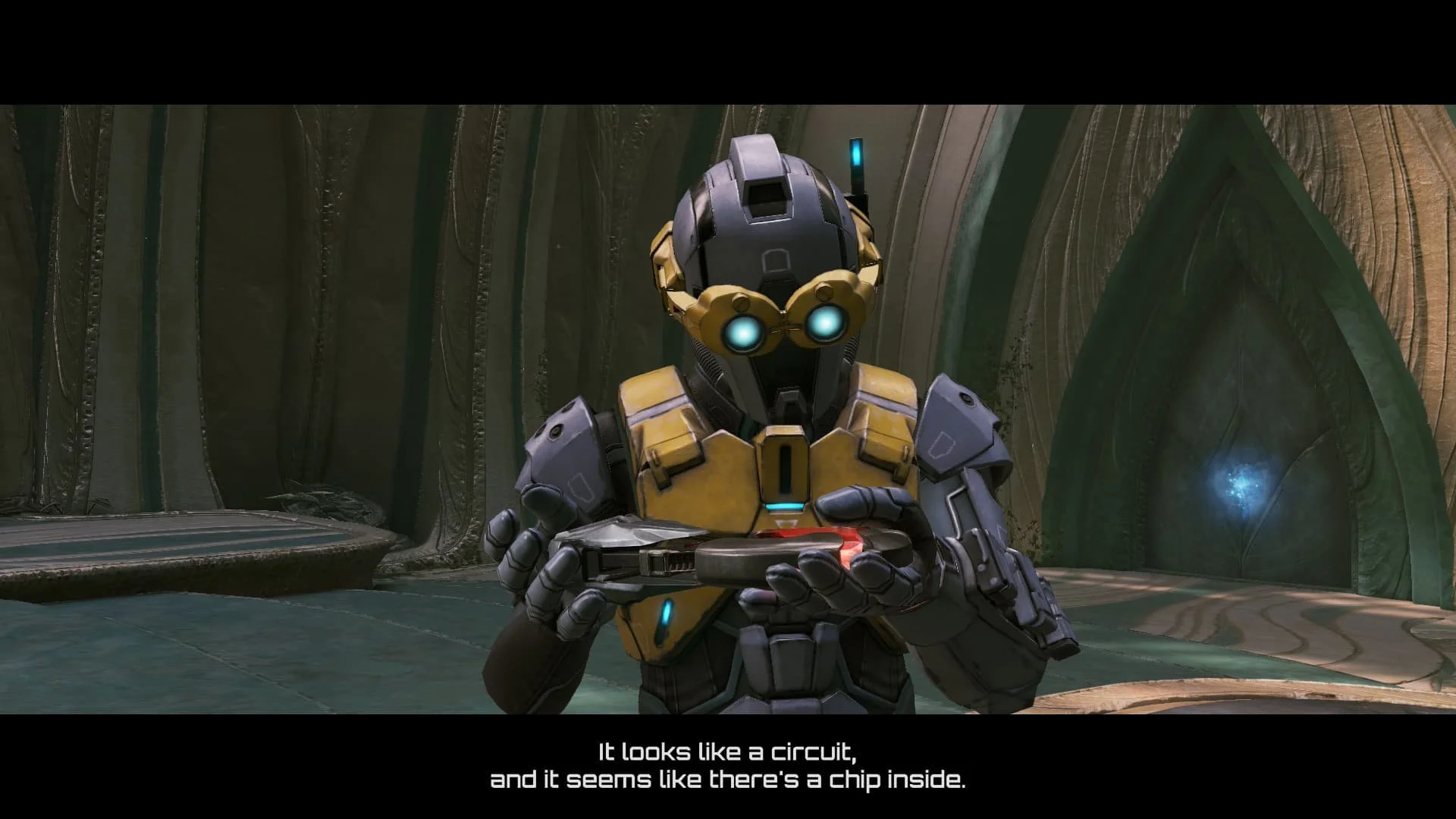
Regarding the other NPCs, much hoopla has been made of them online. I understand the NPC hate because they ruin the vibe, but I actually liked the lone sniper Tokabi, who shares a little about his faith in the deity Sollan. The badass robot who’s meant to be a pilot for a mech, VUE-995, isn’t bad either. The funniest scene in the game involves VUE showing up late for a mini-boss battle. He apologies for missing the action, and Samus just shrugs. Duke is a fine Sergeant, but chatty Myles and “girly-girl” Armstrong (the developer’s words, not mine), who fangirls over Samus, stink of cringy, self-aware Millennial writing. On the rare occasion where their faces are animated, they’re all well-rendered, but for the most part you’ll be looking at four folks in helmets.
The real issue when it comes to these NPC encounters is Samus Aran herself, specifically her characterization. She doesn’t say a single word in this game, which makes encounters awkward because she doesn’t even answer direct questions, making her appear to be completely anti-social. She will sometimes respond by showing a map screen or activating a terminal, which is lame. What’s more, if you don’t include her opening ‘hero landing’, her character is passive and not at all badass in the cut-scenes, defying prior Prime games’ portrayals. There are moments where her allies will be fighting off a bunch of foes, but Samus will casually be standing and slowly blasting, or else uselessly watching them struggle. The game’s final sequence and ending also assassinates Samus’ character in a Jake Skywalker fashion that turned me absolutely bitter against this game’s story and actually took a whole point off of this review.
Another thing that had me bitter was the lack of music in Sol Valley, with the ability to play music locked behind the $30 Amiibo paywall. This was an egregious cash-grab, because all you hear in Sol Valley is the sound of your motorcycle, and occasionally, the wind. I saw people claiming online that you could unlock the ability to play music while driving Vi-O-La, but I never saw any proof of this, and if it really did take getting to 100% scans and collectibles to unlock, then it’s completely useless for the first 99% of your playthrough, especially the long stretch of gameplay where you’ll be doing nothing but driving around smashing into and Power Bomb-ing green crystals for nearly two hours, artificially lengthening the gameplay time to take it over 10 hours. It took me even longer, because I was so bored and drowsy that I got ganked mid-crystal hunt and lost 45 minutes of progress.
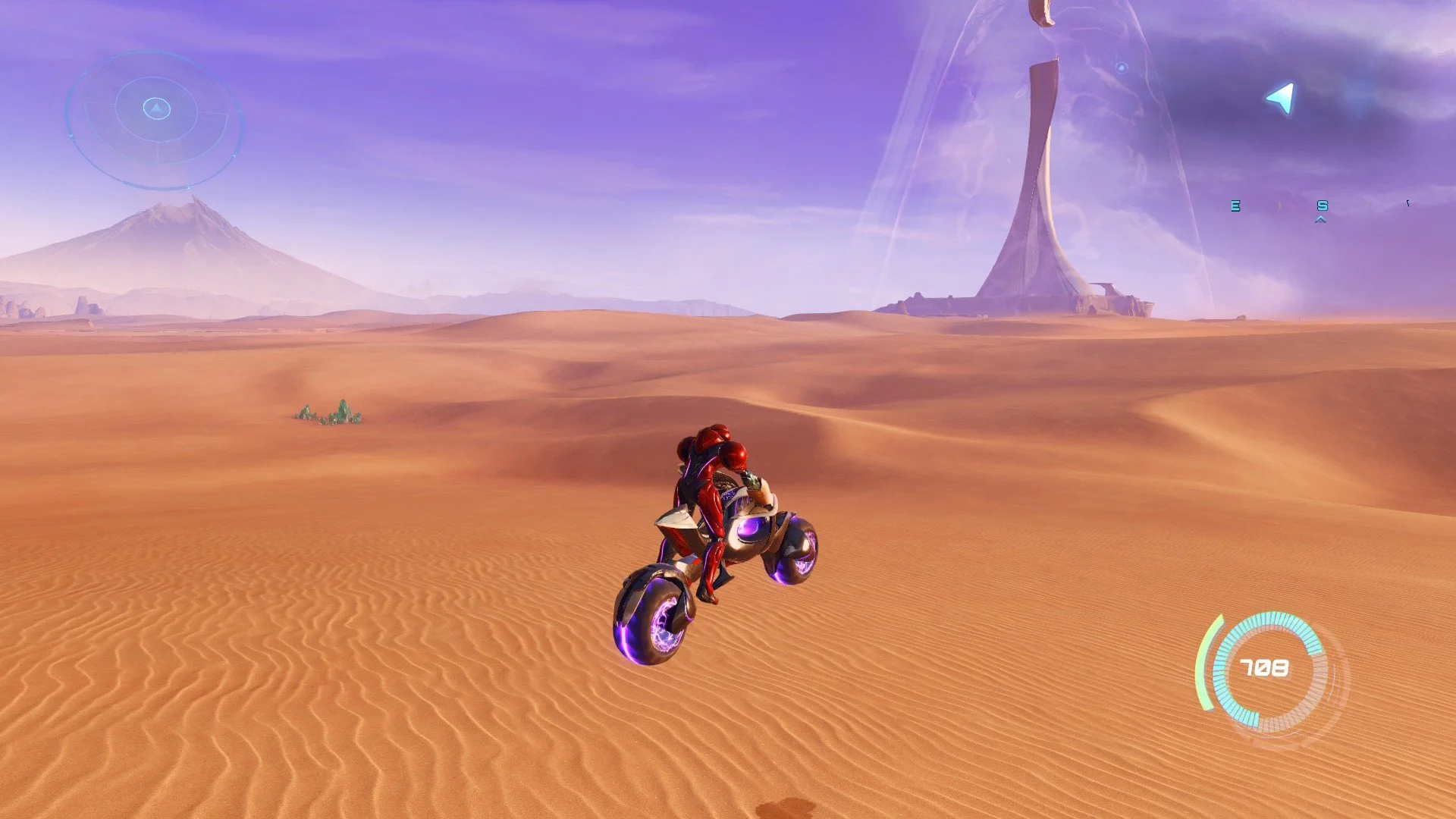
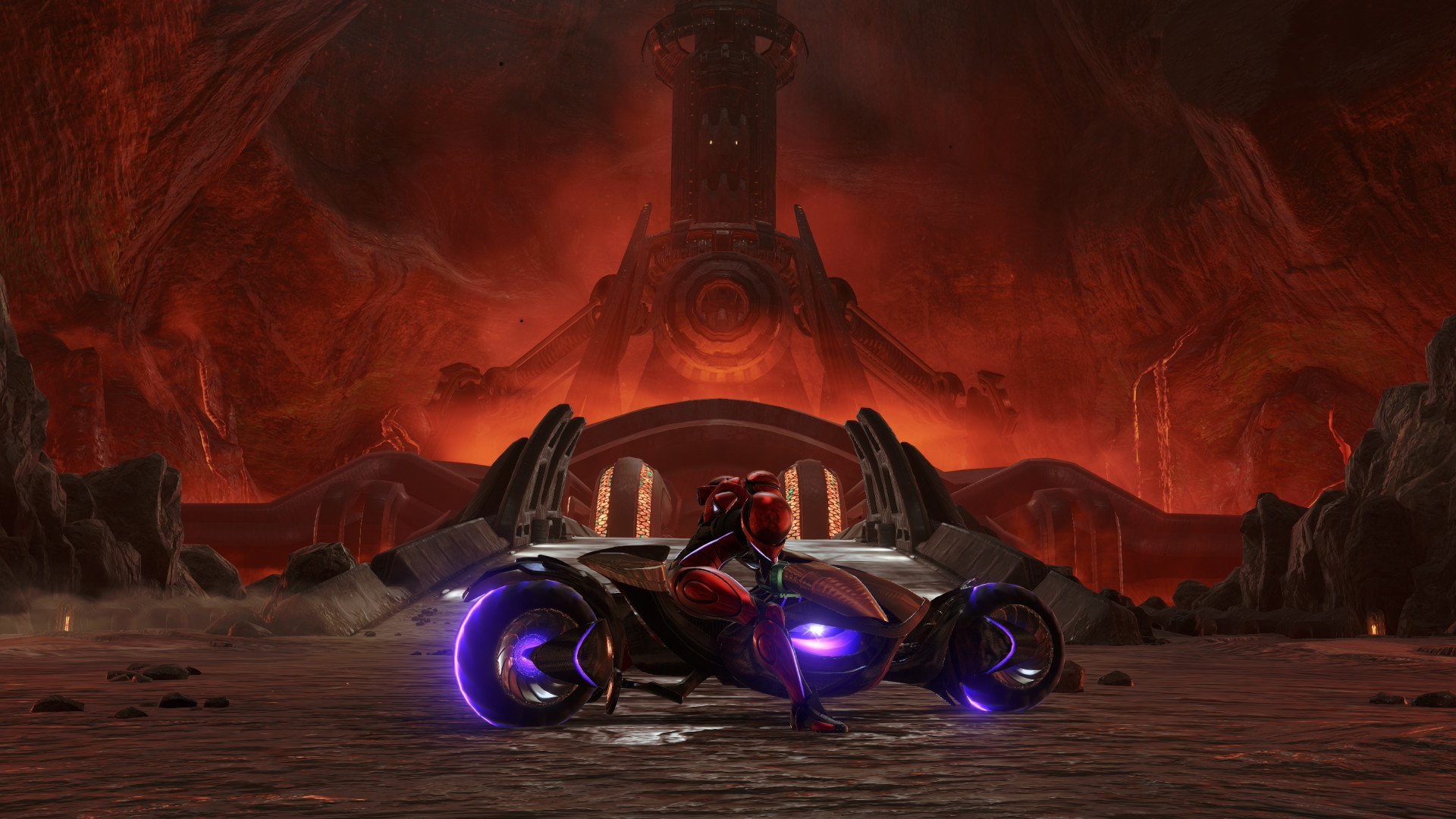
Visually, the game is mostly impressive. Props are due for the Vi-O-La suit, which looks slick. There are some jaw-dropping vistas to be seen on occasion, but unfortunately there are also quite bland sections, like the dune-filled desert of Sol Valley, which completely lacks a day-night cycle or any variety in the skybox, or the drab mines that have no character at all. The game’s performance on the other hand is rock-solid, as you’ll have the choice between 4K 60fps or 1080p at 120fps. I went with the higher framerate and the game always felt silky smooth. Loading times were present, hidden by cut-scenes whenever you transfer between biomes and the desert, or into one of the game’s handful of shrines. They still do hide some loading behind opening and closing doors, but for the most part, doors open much quicker than in previous games. Hats off to Retro Studios and Nintendo for excellent overall performance on Switch 2. I also appreciated the inclusion of an Art Gallery.
There are a lot of puzzling decisions here. Hard mode is locked behind first finishing a Normal mode playthrough. Scans don’t carry over to NG+, and unlike the first 3 games, there’s no colored indicator to tell you which scans are necessary for 100% completion, so you need to scan absolutely everything.
Series producer and Galactic Federation enjoyer Kensuke Tanabe (Metroid Prime: Federation Force) is credited as writing ALL of the scan text, and unfortunately the vast majority of it is not interesting to read, which is a major downgrade from the original trilogy’s fascinating entries. The various biomes vary wildly in quality, the large empty desert clashes with the claustrophobic Metroid world design, and the slick vehicle Vi-O-La is not even close to being utilized to its fullest potential. There isn’t even an escape sequence with Vi-O-La, which should have been a no-brainer. There is an escape sequence in the game involving the Grapple Beam, but it’s pretty much impossible to fail. I finished it with over a minute and a half left on the clock. It truly feels like developers from both sides of the Pacific may have been at loggerheads, or perhaps design elements were lost in translation, rushed, or simply unfinished.
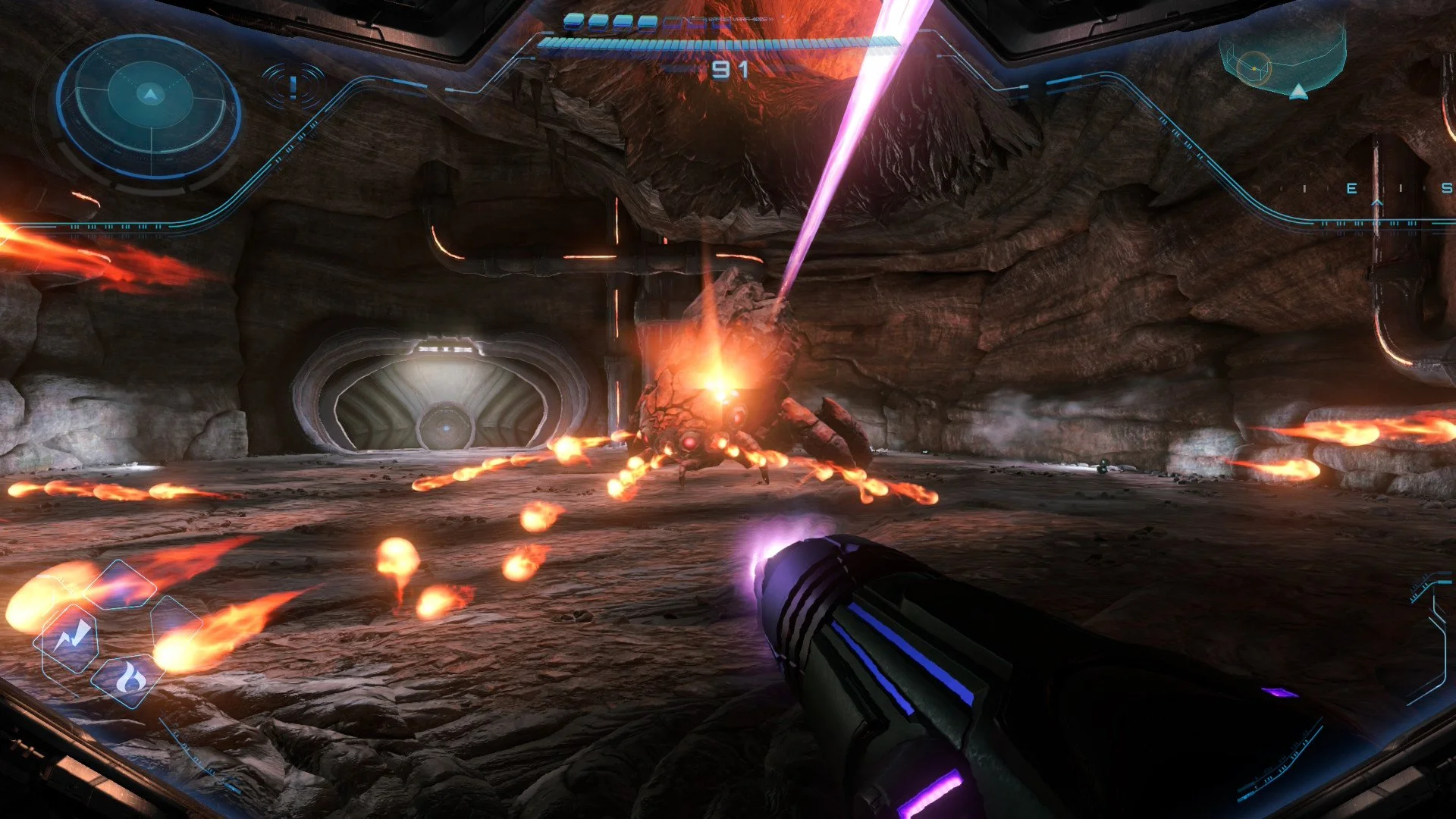
In the first Prime games, Retro had different gamers’ preferences in mind and let us turn hints off. Areas opened up and connected in surprising ways, with many tucked-away secrets that you couldn’t see on a map. The more vertical level design invited players to see rooms from various vantage points. If you were playing Metroid Prime for the first time, you might spend hours in Phendrana Drifts or Magmoor Caverns just exploring. In Metroid Prime 4: Beyond, you’ll be lucky to spend 50 minutes in their equivalent ice and fire areas, because progression is a straight line.
What was the vision here, exactly?
So how did the same studio who made the excellent Prime Trilogy drop the Morph Ball so hard? We may have the answer. According to a recent Famitsu interview with the Japanese side of the development team, Retro Studios did not have the resources or capability to develop a Metroid Prime game when they were brought onto this project. They had to hire staff who formerly worked at other western studios, including a significant number of developers from 343 Industries who likely worked on Halo 4, 5, and Infinite, and they were also apparently tasked with forging ahead with clashing concepts and ideas from the game’s previous iteration. So not only were less than 30 of the 72 developers credited during the Prime Trilogy era in Beyond’s credits, but they were co-developing with 21 other studios. It’s no wonder there was no cohesion here. The game’s focus is clearly pulled in too many different directions, with none of them excelling.
On the one hand, Prime 4: Beyond wants to drop the player into linear Zelda dungeon-like biomes. It also wants to have a big open world. It wants to evoke the sense of isolation that the Metroid series is known for, but it also wants to develop a cast of characters that grow on the player. Prime 4 also wants to shift more of its focus to combat this time around, but it also seriously limits the variety of the enemies Samus encounters and provides disappointing beams. Retro et al. also clearly spent a lot of time perfecting the Vi-O-La motorcycle and its physics, and the HD Rumble on the Pro Controller is painstakingly detailed and immensely satisfying. So why is the vehicle’s only real use traveling across a vast empty desert and awkwardly fighting off enemies while collecting crystals? Why does the game force you to save when in the final area, but not allow you to leave it after you beat the game, essentially locking you into a forced incomplete playthrough with no warning whatsoever? While not all of these things are bad ideas, more than half of them are contradictions in terms.
You know it’s bad when even Nintendo‘s biggest fans, such as YouTuber Beat ‘Em Ups, turn on one of the company’s most beloved and highly anticipated games, but I guess everyone has their breaking point. Nearly all of Nintendo’s major properties now are for casual audiences or families. Gone are the games that featured advanced mechanics and puzzle-solving, and were made with more discerning audiences in mind.
It now feels like every game Nintendo makes is tailored towards an attention-deficit Gen Alpha iPad kid who’s using a gamepad for the first time, but deceitfully marketed towards the Millennial parents of those kids as a nostalgia buy. Since F-Zero and Star Fox are both on ice, Sin and Punishment, Wave Race, Excite, Pilotwings, and 1080 are nowhere to be seen, and 3D Zelda is evolving into just another open-world IP with gimmicks, Nintendo has hardly any franchises left that can be considered to appeal to their shrinking number of hardcore gamer fans (or at least those who don’t have the time to sink into Fire Emblem or Xenoblade Chronicles). So you’d think that Nintendo would treat those precious few hardcore IP carefully, but that was not the case with Metroid Prime 4: Beyond.
The aforementioned Famitsu article also confirms the fan theory that Nintendo saw the positive sales garnered by The Legend of Zelda: Breath of the Wild and decided to try a more linear, open-world, modern AAA dialogue-heavy approach to bring in new fans. It also confirms that halfway through the rebooted development, they realized that this wasn’t what fans wanted, but it was too late to change course again. While the game immediately feels like a retro throwback with visual polish, it really stands out like a red-headed stepchild when stacked up against the original trilogy.
For some, this might be the most accessible Metroid Prime game. I’m sure there’s no shortage of would-be bounty hunters who’d benefit from giving this game a shot, but for those who love the Metroid Prime trilogy for its unique gameplay loop, sense of isolation and mystery, and astonishing level design, it feels like a huge downgrade. I tried desperately to find something to latch onto and love here. But nothing sticks. It is simply inferior to the first trilogy, two games of which were made two decades ago.
I have never been so disappointed in a video game in my entire life, and unless something drastic changes with the Metroid Prime series, I don’t see any hope for it going forward. Especially knowing the quality of the product they’re putting out, Nintendo 100% should not have priced this game at $70 - that insult, coupled with the fact that they don’t drop prices on their first-party games, is why I’m giving this a failing grade. As much as I love the Donkey Kong Country Returns games, Nintendo should have let Retro Studios make Prime 4 back in the 2010s instead. Who knows? It might have been bomb-diggity instead of just a stinkbomb.
Verdict: 2 / 5 (Poor)
PROS
Nearly flawless performance, with hardly any frame drops and slick graphics
Vi-O-La controls well and has great HD Rumble
Several boss battles are actually challenging
CONS
Completely uninspired, linear level design with no exploration or environmental puzzles
Lackluster story brought down by a series-worst characterization of Samus Aran
Useless and ugly open world desert necessitates over 2 hours of mandatory padding
Far less enemy variety than in previous titles
Music in the desert locked behind a $30 Amiibo
What I’ve Played
Rolled credits in 14 hours, including the full hour where I drove around the desert collecting crystals, got drowsy, got ganked out of nowhere, and lost all progress
Got 87% completion and 93% scans
About the Author - Joseph Choi
Filipino-American gamer, professional shepherd and farmer, author, and filmmaker/videographer living in Central California. First consoles were the Game Boy and Sega Genesis, and I've been gaming since then, with a focus on Nintendo and Sony consoles.
Our The Blood of the Dawnwalker review explores Rebel Wolves’ dark fantasy RPG, its 30-day time limit, the day and night cycle curveball, excellent side quests, and shortcomings.